Artikel KPKNL Surabaya

How to Build Effective Teams in an Organization
Trivita Kuswijayanti
Jum'at, 25 Juli 2025 |
267 kali
The usage of teams has become a highly popular way of working across various organizations (Steven &Campion, 1994). A team is a group of individuals utilizing their distinct skills for organizational objectives (Neck et al., 2017). Teams may accelerate specific categories of tasks. However, teams do not frequently achieve optimal performance because most organizations are not aware of how to build effective teams.
Neck et al. (2017) stated that teams will be effective if their capacity can improve quality and simplify processes that eventually achieve organizational goals. One method to analyze teams effectiveness is to examine them through a set of contextual factors that affect their function, composition, processes, and outcomes. The following figure demonstrates the impact of these factors on team effectiveness.
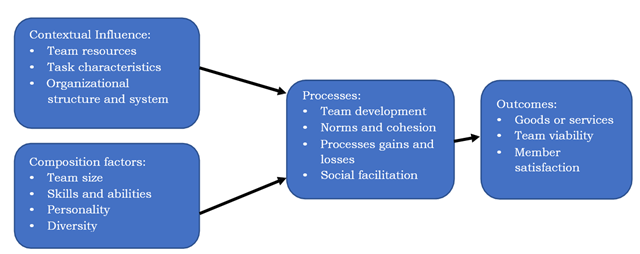
Sources:Neck et al.2017, Factors and Impacts on Team Effectiveness
Contextual Influences
- Team resources
Resources include the equipment, materials, training, information, personnel, and budget that the organization provides to facilitate the team's objectives (Neck et al., 2017).
- Skill and abilities
Skills and abilities serve as the primary capital that employees use to complete their tasks. Employees might receive training to improve their skills and competencies. Effectively managing ability diversity begins with the recruitment of personnel whose skills align optimally with the position. This approach consequently results in increasing productivity and job satisfaction (Neck et al., 2017).
- Task characteristics
Task characteristics might be structured or unstructured, complicated or simple, and defined by varying degrees of interaction among team members (Neck et al.,2017).
- Organizational structure and system
Performance management systems, reward & punishment systems, and administrative & managerial structures must align with team structures to ensure efficient operation (Neck et al., 2017).
Composition factors
- Team size
The specifics of the task determine an appropriate team size. Expanding team size might reduce productivity. Free-riding among team members may occur. On the other hand, communication costs increase dramatically because a big team size requires more coordination (Holmstrom,1982; Malone & Crowston, 1994).
- Personality
Teams generally require a balance between extraverts and introverts in terms of personality (Spreitzer, 1995). If there are too many extraverts, the team may experience excessive talking and insufficient listening; conversely, if there are too many introverts, communication among team members may be minimal (Pink,2001; Pfeffer, 2006).
- Diversity
Diversity includes both superficial attributes, including race, ethnicity, gender, sexuality, and age, as well as intrinsic characteristics, such as personality and beliefs. From a team composition standpoint, managers primarily focus on how deep-level diversity elements, such as introversion and extraversion, influence teamwork. Team members who have the same goals, personalities, and interests generally cultivate favorable social relationships, hence enhancing the team's effectiveness (Neck et al., 2017).
Processes
- Team development
Team development is designed to improve individuals' ability to accomplish collaborative tasks. Team development enables teams to minimize errors and maximize expertise. Team development could be measured by relationship conflict, team creative processes, team tacit knowledge sharing, team knowledge utilization, helping behaviors in the team, trust between team members, team potency, team goal clarity and commitment, task cohesion, social cohesion, team members’ learning in the team, team members’ level of vitality, participation in decision making, and task interdependence (Carlos et al., 2018).
- Norms and cohesion
The employee ethics code promotes norms and cohesion among employees in the organization. Norms and cohesion are implemented to maintain compliance and discipline in the business's internal processes. Organizations will gain from this compliance and discipline, which will foster a positive work atmosphere and improve employee productivity (Neck et al., 2017).
- The Processes of gains and losses
The processes of gains or losses often occurs in a team. Turoff (2000) suggested that the following variables could identify the process of gains and losses within a team.
| The Processes of gains | synergy, learning, stimulation, more information, more objective evaluation, individual problem solving, incubation and reflection.
|
| The Processes of losses | attention blocking, failure to remember, conformance pressure, free rider, air time, attenuation blocking, concentration blocking, socializing, domination, information overload, flaming, slower feedback, fewer information cues, incomplete use of information, incomplete task analysis, ambiguity in language, and coordination problem.
|
Sources: Turoff (2000), Processes Gains and Losses
- Social facilitation
Social facilitation refers to the phenomenon wherein individuals perform better on simple tasks in the presence of others. In contrast, their performance will be worse when completed singly. The presence of others on more difficult tasks, however, actually degrades performance. Zajonc (1965) concluded that the presence of others, acting as spectators or co-actors, facilitates the emission of dominant responses. Ferris (1978) stated that human life is based on the function of togetherness, and the presence of others differentially affects employee performance within an organization. Human resource managers must focus on optimizing team performance by organizing the team with an understanding of social facilitation, thereby ensuring the effective and efficient achievement of team goals.
Outcomes
- Goodsand services
Effective systems facilitate the creation of a value chain by teams. Ultimately, teams provide valuable products and services for consumers (Neck et al., 2017). Moreover, consumer happiness is often assessed through surveys. The survey results are assessed to enhance the value of goods and services.
- Team viability
Team viability relates to a team's capacity to sustain itself and attain success in future performance contexts (Bell & Marentette, 2011). Viability is distinctive, as it is a higher order construct that encompasses both the present condition of the team and its potential for future success (Hackman,1987; Bell & Marentette, 2011). The construct of
- Member satisfaction
The satisfaction of team members significantly influences the overall performanceand well-being of the team. Instrumental satisfaction and social satisfactionare two dimensions related to satisfaction that seem to positively influenceteam performance (Nerkar et al., 1996). Instrumental satisfaction refers to ateam member's satisfaction with the team's achievements, whereas socialsatisfaction is related to the interactions among team members.
References
Bell, S.T. & Marentette, B.J. 2011.Team viability for long-term and ongoing organizational teams. Organizational Psychology Review, 1(4), 275-292.
Carlos Ferreira Peralta, Paulo Renato Lourenço,Paulo Nuno Lopes, Cátia Baptista & Leonor Pais. 2018. Team development: Definition, measurement and relationships with team effectiveness, Human Performance, DOI: 10.1080/08959285.2018.1455685
Cooperstein, J. N. 2017. Initial development of a team viability measure (Doctoral dissertation, DePaul University).
Ferris, Gerrald R. etal. 1978. Social facilitation: A review and alternative conceptual model. The Academy of Management Review , Apr., 1978,Vol. 3, No. 2 (Apr., 1978), pp. 338-347 https://doi.org/10.2307/257673
George, Jennifer M. & Jones, Gareth R. 2012. Understanding and managing organizational behavior. Pearson Education Inc
Hackman, J.R. (1987). The design of work teams. In J. L. Lorsch (Ed.), Handbook of organizational behavior (pp. 315–342). Englewood Cliffs, NJ: Prentice-Hall.
Holmstrom B. 1982.Moral hazard in teams. The Bell Journal of Economics. p. 324–340. doi: 10.2307/3003457
Malone TW & Crowston K. 1994. The interdisciplinary study of coordination. ACM Computing Surveys(CSUR) 26(1):87–119.doi: 10.1145/174666.174668
Neck, Christopher P. et al. 2017. Organizational behavior: A critical thinking approach. Sage Publishing, Inc.
Nerkar, A.A., McGrath,R.G., & MacMillan, I.C. (1996). Three facets of satisfaction and their infuluences on performance of innovation teams. Journal of Business Venturing, Vol. 11, pp. 167-88
Pfeffer, Jeffrey. 2006.Why Free Agents Don’t Feel Free. Business2.0 7, no. 9 (October2006): 78
Pink, Daniel H. 2001.Free Agent Nation: The Future of Working for Yourself (New York: Warner Business Books)
Spreitzer, Gretchen M.1995. Psychological, Empowerment in the Workplace: Dimensions, Measurement and Validation. Academy of Management Journal38, no. 5 (October 1995): 1442–1465
Steven, J.M. &Campion, M.A. 1994. The knowledge, skills and abilities requirements forteamwork: Implications for human resources management. Journal of Management,Vo.20, No.2 503-530 https://doi.org/10.1177/014920639402000210
Turoff, Murray. 2000.Management foundation areas. Second set notes for course in New Jersey Institute for Technology, p.132, https://web.njit.edu/~turoff/coursenotes/IS679/679newset2/sld001.htm
Woodman, R. W., &Sherwood,J.J.1980. The role of team development in organizational effectiveness: A critical review. Psychological Bulletin, 88(1),166–186. https://doi.org/10.1037/0033-2909.88.1.166
Zajonc, Robert B.1965. Social facilitation. Science , New Series, Vol. 149, No. 3681 (Jul.16,1965), pp. 269-274, https://www.jstor.org/stable/17159
Written by: Muhamad Aripin, KPKNL Surabaya
| Disclaimer |
|---|
| Tulisan ini adalah pendapat pribadi dan tidak mencerminkan kebijakan institusi di mana penulis bekerja. |